Be Vigilant for Invasive Asian Hornets!
Thank you to Sue Abbott for her fascinating report on invasive Asian Hornets at our Annual Parish Meeting on 4 April 2024.
Published: 4 April 2024

Asian Hornet
Vespa velutina nigrithorax
The Asian hornet is an invasive non-native hornet from Asia. It is a highly aggressive predator of insects and poses a significant threat to our ecology. In 2004 it was accidentally introduced to France, it spread rapidly across Europe and is now crossing the channel into the UK. Asian hornets fly across the channel, they also hitch rides on vehicles and goods, so the areas at greatest risk are ports and transport links. Sitting in the M3/M4 corridor puts us at risk, nests have been found (and destroyed) in London, Ascot and Slough. Understanding its present and potential dangers is crucial for responsible community action.
Why are beekeepers concerned?
Social insects (like bees) are an easy lunch for the hornets because there are thousands of them in one place. The hornets hawk around the hives, plucking bees from the air to feed to their larvae. Sometimes the hornets take a few bees, sometimes they take a lot, but the scent of just one or two hornets around the hive is enough to stop the bees from leaving the hive, normal behaviour stops, the bees become very stressed. The bee colony may fail because of the number of bees the hornets have taken, equally the stress caused by the hornets presence can cause the colony to fail. Beekeepers take the health and welfare of their bees very seriously.
Why should we be concerned?
- Threat to honeybees: Asian hornets favour social insects, like bees and wasps, but will eat all insects. They hover near beehives, snatching returning bees, and butchering them to feed their larvae. This can decimate bee colonies, impacting pollination and honey production. Portugal have noted at 35% reduction in honey production (BBKA news February 2024).
- Ecological Disruption: Asian hornets are aggressive insect predators, one nest needs around 100,000 insects to feed their larvae in a year. This level of predation has a brutal effect on the local ecology. Our native insects all have important jobs, including pollination, clean up crew and being a food source for other insects, birds, reptiles and mammals. Later in the year, Asian hornets will feed on ripe fruits, which then rot and have had devastating effects on crops such as wine grapes.
- Potential Public Health Concern: While not overly aggressive towards humans, Asian hornets have been known to defend their nest area vigorously. The sting causes pain and allergic reactions in some individuals. For outdoor workers, this could be harmful.
What can we do?
- Be vigilant: Learn to identify Asian hornets and report sightings to relevant authorities.
- Raise awareness: Spread information about Asian hornet within your community. Educating neighbours can lead to early detection and control measures.
- Participate in our community programme: help us monitor and trap Asian hornets, contributing valuable data for tracking their spread.
Sue and the team would be happy to offer a presentation/talk to community groups. If you would like know more, please contact Sue via email asianhornet@rbka.org.uk.
How to identify an Asian hornet
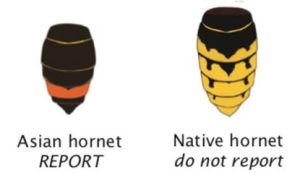 The Asian hornet has distinctive markings; yellow legs and an orange band on the fourth segment on its black body. European hornets are brown and have yellow abdomens and brown legs, they are larger than an Asian hornet.
- Striking yellow ‘socks’ – leading to its common name in Asia of the ‘yellow-legged hornet’
- Slightly smaller than our native European hornet but larger than a common wasp
- Darker than European hornet and many types of wasp, but has a distinct orange face and an orange-yellow band towards the tail end of its abdomen
What to do if you see an Asian Hornet
If it’s safe to do so, try and take a photo
Use What3Words to pinpoint your location: https://what3words.com/
There are a number of ways to report your sighting:
- Report the sighting via Asian Hornet App: You can download the app for free from the App store for Android or Apple devices.
- Report the sighting via email: alertnonnative@ceh.ac.uk.
- Use this link to access the online reporting form: Non-native Alert – Asian Hornet (brc.ac.uk).
See it! Snap it! Send it!


Sue Abbott, Reading & District Beekeeping Association, Asian Hornet Action Team, January 2024
Email: asianhornet@rbka.org.uk
